Best Internet for Off-Grid Cabins & Rural Properties in Canada (2026)
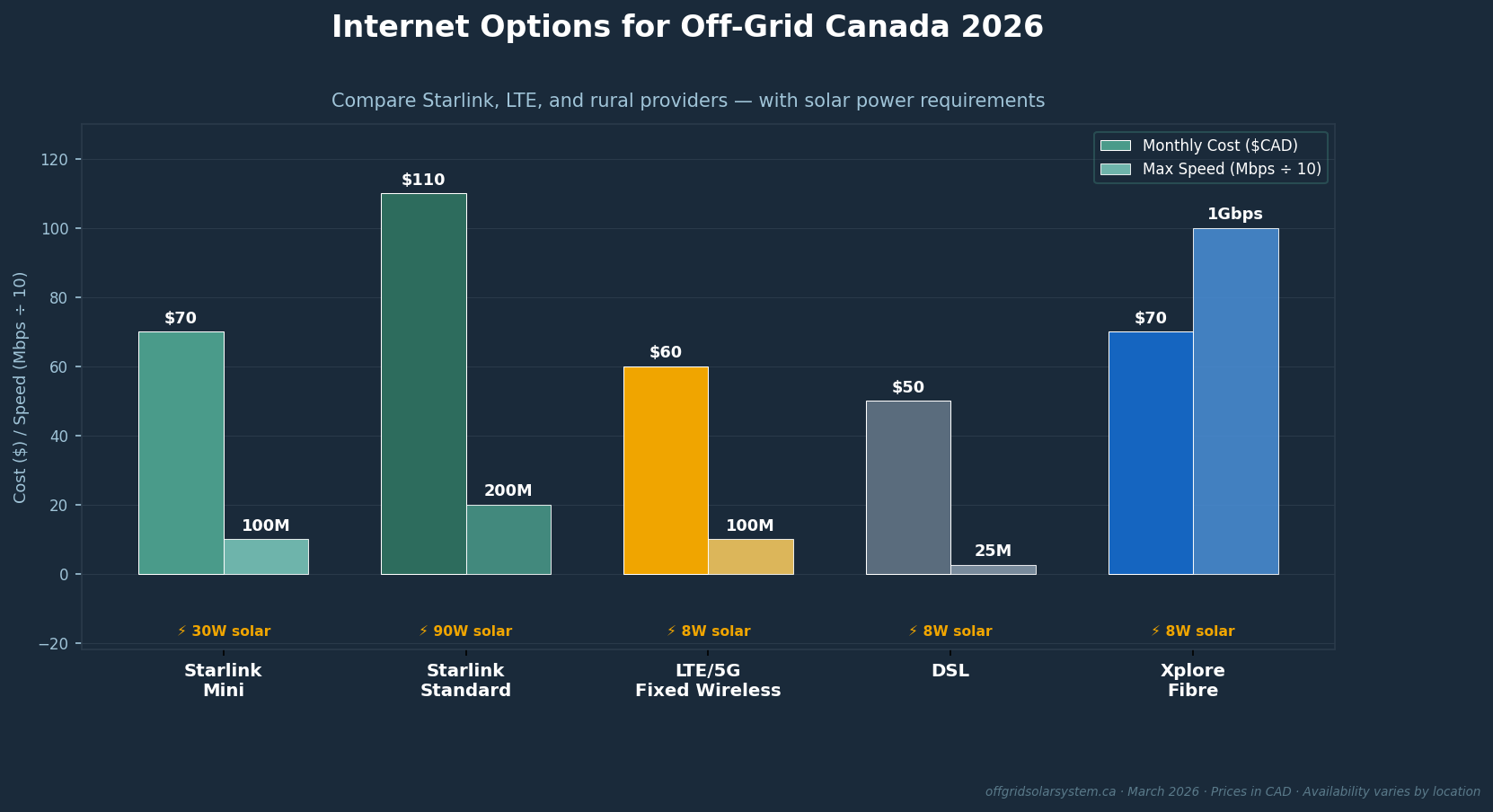
Monthly cost, max speed, and solar power requirement for each option — March 2026 Canadian pricing
The 2026 Canadian Off-Grid Internet Landscape
Three years ago, the honest answer for a truly remote off-grid Canadian property was "you probably won't have reliable internet." That's no longer true. Starlink's expansion, improved LTE coverage from Telus, and the rollout of fixed wireless services have made reliable connectivity achievable from almost anywhere in Canada — but the right solution depends heavily on your location, budget, and how much solar capacity you have available.
The Canadian federal government has committed to bringing high-speed internet to 98% of Canadians by 2026 and 100% by 2030 through the Universal Broadband Fund — meaning coverage gaps are closing every year. For truly remote off-grid properties, though, Starlink remains the most reliable solution.
Option 1: Starlink
🛰️ Starlink (SpaceX)
Best for remote off-grid Available across CanadaStarlink is the go-to choice for any off-grid Canadian property beyond LTE tower range. With over 9.2 million global subscribers and coverage across all of Canada including the territories, it's the first satellite internet service that's genuinely fast and low-latency enough for real work, video calls, and streaming.
Current Canadian Plans (March 2026)
Hardware: Standard kit ~$399 (free rental in select areas). Note: Starlink periodically offers promotional pricing — a $55/month 6-month promo was available through March 31, 2026. Check Starlink.com/ca for current offers at your address.
⚡ Solar Power Requirements
| Starlink Model | Active Power Draw | Daily kWh (24/7) | Daily kWh (8hrs/day) | Solar Array Needed* |
|---|---|---|---|---|
| Starlink Mini | 20–40W | 0.5–1.0 kWh | 0.2–0.3 kWh | 100–200W extra |
| Standard (Gen 3) | 75–100W | 1.5–2.0 kWh | 0.6–0.8 kWh | 300–500W extra |
| High Performance | 110–150W | 2.5–3.6 kWh | 0.9–1.2 kWh | 500–800W extra |
*Additional solar array capacity needed beyond existing household load. Based on 4–5 peak sun hours/day average.
Starlink Mini — The Off-Grid Favourite
The Starlink Mini is increasingly the preferred choice for off-grid Canadian users. At 20–40W power draw (vs 75–100W for Standard), it uses roughly one-third the power of the full dish while delivering 50–100 Mbps speeds — more than adequate for remote work and streaming. The Mini is also portable, making it useful for seasonal properties. It's available as an add-on to a Residential plan or as a standalone Roam plan.
Option 2: LTE & 5G Fixed Wireless
📶 LTE / 5G Fixed Wireless
Best value where available Coverage dependentIf your off-grid property is within range of an LTE or 5G tower, fixed wireless internet is typically cheaper than Starlink and uses dramatically less power — a fixed wireless router draws only 5–15W. The challenge is coverage: LTE fixed wireless requires a tower within roughly 15–20 km with clear line of sight.
Main Canadian Providers
| Provider | Technology | Speed | Price | Coverage |
|---|---|---|---|---|
| Xplore | 5G Ultra / LTE / Fibre | Up to 500 Mbps | From ~$50/mo | Best rural coverage nationally |
| Telus | 5G / LTE | 25–200 Mbps | ~$84–$105/mo | Strong in BC, AB, ON; best in territories |
| Rogers | 5G Home / LTE | Up to 100 Mbps | ~$60/mo | ON, QC, Western Canada |
| Bell | LTE Home | 25–50 Mbps | ~$60–$85/mo | ON, QC primarily |
| SaskTel | 5G / LTE | Up to 100 Mbps | From ~$42.50/mo | Saskatchewan — best local option |
| MapleWiFi | LTE cellular hotspot | Varies | Varies | Nationwide, portable — good for seasonal cabins |
⚡ Solar Power Requirement
A fixed wireless router draws 5–15W — negligible compared to Starlink. For most off-grid solar systems, adding LTE internet adds less than 0.2 kWh/day to your energy budget. This is the biggest practical advantage of LTE over Starlink for off-grid use.
Option 3: Xplore Fibre & Fixed Wireless
🌐 Xplore (formerly Xplornet)
Best rural-first networkXplore is Canada's largest rural-focused internet provider, operating fibre, 5G Ultra fixed wireless, LTE, and satellite services specifically designed for rural and remote communities. Where available, Xplore's 5G Ultra service delivers up to 500 Mbps with unlimited data from around $50/month — significantly faster and cheaper than Starlink. Their fibre rollout in Ontario and Quebec is expanding rapidly with government Broadband Fund support.
For off-grid properties, Xplore's fixed wireless and LTE services are worth checking first — power draw is minimal (5–15W for the router) and pricing is competitive. Check availability at your specific address at xplore.ca.
What's Coming: Telesat Lightspeed
🚀 Telesat Lightspeed
Canadian-owned · Mid-2026 targetTelesat is a Canadian satellite company (headquartered in Ottawa) building a low-Earth orbit satellite constellation called Lightspeed, targeting mid-2026 for initial service launch. Unlike Starlink which is American-owned, Lightspeed is Canadian — a politically significant distinction given recent Canada-US trade tensions. Prime Minister Carney has publicly referenced the importance of a made-in-Canada satellite network for national security.
Lightspeed is initially targeting enterprise and government customers rather than residential. Residential off-grid availability is unlikely before 2027–2028. Watch this space — if Lightspeed launches at competitive pricing, it becomes a genuine Starlink alternative with Canadian sovereignty advantages.
How Much Solar Do You Need to Run Internet Off-Grid?
Use this quick calculator to estimate how much additional solar capacity your off-grid system needs to support your chosen internet option.
⚡ Internet Solar Sizing Calculator
Province-by-Province Recommendation
← Scroll to see full table →
| Province | Best Option for Remote Off-Grid | Best LTE Provider | Notes |
|---|---|---|---|
| British Columbia | Starlink (coastal) / LTE (interior valleys) | Telus | Telus has best rural BC coverage; Starlink Mini ideal for boat-access properties |
| Alberta | LTE/5G first, Starlink if no tower | Telus / Rogers | Good LTE coverage across most of rural AB; check before buying Starlink |
| Saskatchewan | SaskTel LTE first, Starlink for remote | SaskTel | SaskTel government-owned, best local coverage and pricing in SK |
| Manitoba | LTE in south, Starlink for north | Rogers / Bell | North of Lake Winnipeg — Starlink only viable option |
| Ontario | Xplore or LTE first, Starlink for Shield country | Telus / Bell | Canadian Shield cottage country — Starlink Mini most practical; LTE patchy |
| Quebec | Xplore fibre (Laurentians), Starlink for remote | Bell | Xplore fibre expanding rapidly in rural QC; Starlink for Abitibi and north |
| Atlantic Canada | LTE generally good, Starlink for islands | Bell / Rogers | PEI and NS mainland well-covered; Cape Breton and NB backcountry need Starlink |
| Territories | Starlink — only viable option | Telus (limited) | Telus only carrier with any territory LTE; Starlink essential for off-grid |
Full Comparison: All Options Side by Side
← Scroll to see full table →
| Option | Monthly Cost | Speed | Power Draw | Daily kWh | Coverage | Best For |
|---|---|---|---|---|---|---|
| Starlink Mini | $70+ /mo | 50–100 Mbps | 20–40W | 0.5–1.0 kWh | All Canada | Power-conscious off-grid, seasonal |
| Starlink Standard | $70–$140/mo | 100–400 Mbps | 75–100W | 1.5–2.0 kWh | All Canada | Full-time remote off-grid |
| LTE Fixed Wireless | $50–$105/mo | 25–200 Mbps | 5–15W | 0.1–0.4 kWh | Within tower range | Best value where available |
| Xplore 5G Ultra | From ~$50/mo | Up to 500 Mbps | 5–15W | 0.1–0.4 kWh | Select rural areas | Rural communities, farms |
| Xplore Fibre | ~$70/mo | Up to 1 Gbps | 5–10W | 0.1–0.2 kWh | Rural ON/QC expanding | Rural towns with fibre access |
| DSL | $40–$70/mo | 5–50 Mbps | 5–10W | 0.1–0.2 kWh | Where phone lines exist | Older rural communities only |
Adding internet to your off-grid solar system?
Use our solar sizing calculators to make sure your system can handle the extra load — then get free quotes from certified Canadian installers.
Size Your Solar Array → Get Installer QuotesFrequently Asked Questions
Is Starlink worth it for a Canadian off-grid cabin?
For a cabin more than 20 km from the nearest LTE tower, yes — Starlink is almost certainly worth it in 2026. At $70/month for 100 Mbps with no data caps, it's genuinely fast enough for remote work, video calls, and streaming. The Starlink Mini is the best choice for power-conscious off-grid setups, drawing only 20–40W vs 75–100W for the Standard dish.
How much solar do I need to run Starlink off-grid in Canada?
For Starlink Mini running 24/7: add roughly 100–200W of additional solar panel capacity and 0.5–1 kWh of battery storage. For Starlink Standard running 24/7: add 300–500W of solar and 2–3 kWh of battery. In winter in most Canadian provinces, add 30–40% more capacity to account for reduced solar production. Use the solar calculator above for province-specific estimates.
Does Starlink work in Canadian winter and extreme cold?
Yes — Starlink is designed for cold climates and works reliably at -40°C. The built-in snow melt feature heats the dish to clear ice and snow automatically. The main consideration for off-grid users is that snow melt mode can spike power draw to 150W+, which can drain batteries overnight in winter. Set Snow Melt to "Auto" (not "Always On") to minimize unexpected power consumption.
Can I use LTE internet with solar off-grid in Canada?
Yes, and it's significantly more power-efficient than Starlink. An LTE router draws 5–15W — negligible for any off-grid solar system. The challenge is coverage: LTE requires a cellular tower within range. Check Telus, Rogers, and Bell coverage maps at your specific property address before deciding between LTE and Starlink.
What about the Ontario Starlink cancellation — does it affect residential users?
No — Ontario's cancellation was a government contract for institutional connectivity, not residential service. Individual Starlink subscriptions in Ontario are unaffected. The cancellation reflects political tensions with the US (Starlink's parent company SpaceX is American), which is why the Canadian government is accelerating support for Telesat Lightspeed as a made-in-Canada alternative.
What's the cheapest internet option for a remote Canadian cabin?
If you have LTE coverage: a Rogers or Bell LTE home internet plan at $60–$85/month is typically the cheapest option. If you're beyond LTE range: Starlink at $70/month (Residential 100 Mbps) is the most affordable satellite option. A Starlink Roam plan at $50/month works if you only need internet part-time and don't need a fixed address plan.
Related Solar Calculators
📊 Sources
- Starlink Canada — Service Plans and Pricing (March 2026)
- Drive Tesla Canada — Starlink March 2026 promotional pricing
- EcoFlow — Starlink Power Consumption Guide
- Power Queen — How to Power Starlink Off Grid (2026)
- NetSpeed Canada — Best Rural Internet Providers Canada 2026
- PlanGenius — Best Internet for Rural Canada 2026
- TELUS — Wireless Rural Home Internet
- NRCan Provincial Peak Sun Hours data — used for solar sizing estimates
Internet pricing and availability data reflects March 2026 Canadian market information. Starlink promotional pricing (e.g. $55/month offer) may have expired — check Starlink.com/ca for current plans at your address. LTE coverage varies significantly by exact location — always verify coverage at your specific property before purchasing equipment. Solar sizing estimates are approximate and based on average provincial peak sun hours; actual performance depends on panel orientation, shading, and seasonal variation.