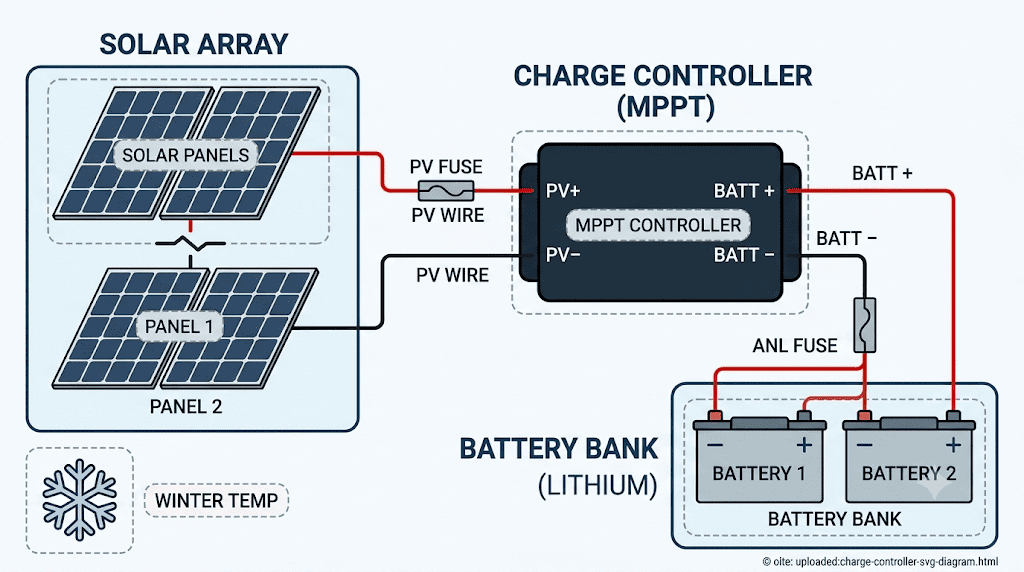
Solar Panel Configuration
MPPT recommended for most Canadian off-grid systems
Adds 35% safety margin for snow-reflected current boost
Series
×
Parallel
Auto-filled by province selection above
Default −0.30%/°C suits most mono panels
Industry standard: 25% — do not go below 20%
Calculation Results
💡 Pro Tips for Charge Controller Selection
1. Always Size Up: Choose a controller rated 25–30% higher than your calculated amperage. This provides safety margin and extends controller lifespan.
2. Check Voltage Ratings: Ensure your controller's maximum input voltage exceeds your cold-weather adjusted Voc by at least 20%.
3. MPPT Worth the Investment? If your panel array voltage is more than 2× your battery voltage, MPPT pays for itself within 2–3 years through 20–30% more power.
4. Plan for Expansion: Size your controller for your future array now. Upgrading later is expensive and wasteful.
5. Consider Parallel Controllers: For large arrays (>100A), two smaller controllers in parallel is often more reliable than one massive unit.
⚠️ Common Sizing Mistakes to Avoid
❌ Ignoring Temperature Compensation: Cold-weather voltage increase is the #1 cause of controller damage. Always use your region's record low temperature.
❌ Using PWM with High-Voltage Panels: PWM with 60V+ panels wastes 30–40% of your solar power. Use MPPT when panel voltage is 2× battery voltage.
❌ Undersizing for "Cost Savings": A controller running at 95%+ capacity will overheat and fail early. The $50 saved costs $300+ in premature replacement.
❌ Mixing Panel Types: Connecting panels with different Voc in series causes the controller to use the lowest common voltage, wasting output from better panels.
Formulas & Calculation Methods
1. Temperature-Adjusted Voc (per panel)
Adjusted Voc = Voc × [1 + (TempCoeff% ÷ 100) × (25 − Lowest Temp °C)]
Why: Cold weather increases panel voltage — failing to account for this is the #1 cause of controller damage.
2. Total Array Voltage
Total Array Voltage (V) = Adjusted Voc × Panels in Series
3. Controller Amps — MPPT
MPPT Amps = (Total Array Power ÷ Battery Voltage) × (1 + Margin ÷ 100)
Example: (1600W ÷ 48V) × 1.25 = 41.7A → use a 50A MPPT controller
4. Controller Amps — PWM
PWM Amps = Total Array Current (Isc × Parallel) × (1 + Margin ÷ 100)
Frequently Asked Questions
Why adjust Voc for temperature?
Solar panel voltage increases in colder weather. By calculating the coldest-case Voc, you ensure the array won't exceed the controller's voltage rating, preventing permanent damage.
Should I choose MPPT or PWM?
Choose MPPT if your panel voltage is 2× or more than your battery voltage, or if you have a system over 500W. Choose PWM for small budget systems under 300W where panel voltage closely matches battery voltage.
What safety margin should I use?
25–30% for most installations. Never go below 20%. Use 30% if you're in an area with extreme temperature swings or plan to expand your array.
What if my calculated current exceeds controller ratings?
Either choose a larger controller, or split your array into smaller sub-arrays with their own controllers wired in parallel.