Optimal Tilt Angle & Peak Sun Hours: Maximizing Your Off-Grid Solar Power in Canada
By Off-Grid Solar System Canada | Last Updated: February 15, 2026 | Reading time: ~12 minutes
Is your off-grid solar system underperforming in winter? You're not alone. Most Canadian off-grid systems lose 50-70% of their summer output when the cold months arrive—not because the panels stop working, but because they're angled wrong. The good news? A simple tilt adjustment can recover 15-50% of that lost production without buying a single extra panel.
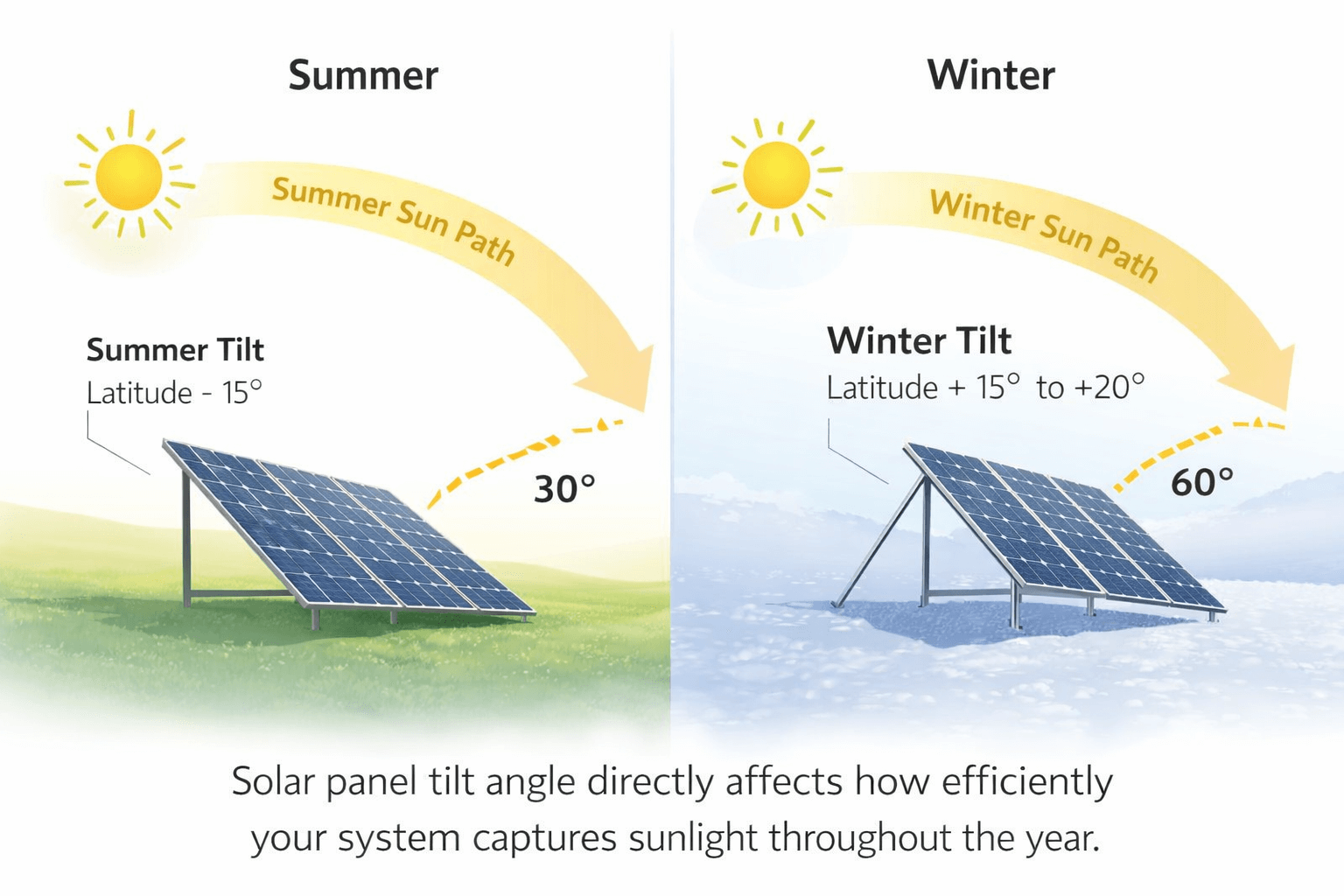
Solar panel tilt angle directly affects how efficiently your system captures sunlight throughout the year.
1. Why Tilt Angle and Peak Sun Hours Matter
Every off-grid solar system depends on two fundamental variables: tilt angle (how steeply your panels face the sun) and peak sun hours (how much usable sunlight your location receives). Get these right, and your system hums along efficiently. Get them wrong, and you're burning expensive generator fuel all winter.
💡 Real Impact: Fine-tuning tilt angle typically improves annual output by 15–25%. For a 5 kW system, that's 2,000–4,000 kWh per year—enough to eliminate most winter generator use.
These two variables determine everything else in your system design:
Daily energy harvest – how many kWh your panels produce
Battery bank sizing – how much storage you need for cloudy stretches
Array sizing – whether you need 3 kW or 8 kW of panels
Generator runtime – how often you're burning fuel in winter
💰 Cost Impact: Getting tilt and PSH right can save $2,000–$5,000 up-front by optimizing array and battery sizes—and avoid $1,200–$2,400 per year in fuel costs.
The best part? Optimizing tilt angle costs almost nothing if you're designing a new system, or just a few hours of work if you're adjusting an existing one.
2. What Is the Optimal Tilt Angle?
Tilt angle is simply the angle between your solar panel and the ground. The physics are straightforward: when sunlight hits your panels at a 90° angle (perpendicular), you capture maximum energy. As that angle becomes more oblique, efficiency drops fast.
Quick Rule of Thumb: For year-round fixed systems in Canada, start with your latitude + 10° to 15°. For example, if you're in Toronto (latitude 43.7°), aim for about 54-58°.
Tilt Recommendations by Use Case
System Type
Recommended Tilt
Best For
Year-round cabin
Latitude + 15°
Winter-heavy loads
Summer cottage
Latitude − 15°
Maximum summer output
Full-time residence
Latitude (seasonal adjust ideal)
Balanced annual production
Workshop/barn
Latitude
Consistent year-round
RV/mobile
Adjustable 10–60°
Location flexibility
Winter requires steeper angles to capture low-altitude sun; summer works better with flatter panels.
The Science: Why Angle Matters
The sun's path across the sky changes dramatically through the seasons. In summer, it arcs high overhead. In winter, it barely clears the southern horizon. This is especially pronounced in Canada's northern latitudes.
Solar panels follow the cosine law: at 30° angle of incidence, you capture about 87% of available energy. At 60°, that drops to just 50%. Proper tilt keeps that angle of incidence small during your critical season.
Key Takeaway: In most Canadian locations, Latitude + 10° to +15° delivers the best year-round compromise—boosting winter performance while shedding snow naturally. Test your specific angle with our Solar Panel Calculator.
3. Understanding Peak Sun Hours (PSH)
Peak Sun Hours (PSH) is one of the most misunderstood concepts in solar. It's NOT the same as "daylight hours." Instead, PSH represents the equivalent number of hours per day when solar irradiance averages 1,000 W/m²—the standard test condition for rating panels.
Think of it this way: 4 hours of PSH might mean 2 hours of weak morning sun, 4 hours of bright midday sun, and 2 hours of weak evening sun. It all gets normalized to the equivalent of 4 hours at full intensity.
Peak Sun Hours Across Canada
City
Fixed Tilt (°)
Summer PSH
Winter PSH
Annual Avg
Vancouver, BC
46
5.1
1.3
3.6
Toronto, ON
43
5.7
1.9
3.9
Calgary, AB
45
6.3
1.8
3.5
Halifax, NS
43
5.1
1.5
3.5
Yellowknife, NT
58
6.7
0.3
3.5
⚠️ Critical Design Rule: Notice how winter PSH is often 1/3 to 1/4 of summer values? This is why you must design for winter, not annual averages. An "average" of 3.6 PSH sounds decent until you realize December delivers only 1.3 PSH.
Monthly Variation Example: Toronto
See Toronto's month-by-month PSH breakdown
Month
PSH (Lat Tilt)
% of June Peak
January
1.8
32%
February
2.3
40%
March
3.4
60%
April
4.5
79%
May
5.3
93%
June
5.7
100%
July
5.8
102%
August
5.2
91%
September
4.1
72%
October
2.9
51%
November
1.9
33%
December
1.5
26%
Where Does This Data Come From?
Our PSH data comes from NASA POWER's 30+ year satellite and ground measurement dataset. It accounts for:
Regional cloud cover patterns
Atmospheric conditions and air clarity
Seasonal sun angle variations
Historical weather averages
Accuracy Note: NASA POWER data uses 0.5° × 0.5° grids (roughly 55 km squares). Your specific microclimate may vary by 5–10%, but this data is far more reliable than guessing or using generic "Canada averages."
Key Takeaway: Always design with the lowest 3-month PSH average (typically Dec–Feb). This determines whether you'll have energy autonomy or be running your generator daily.
4. Real System Performance: Before/After Comparisons
Theory is great, but let's look at what happens when real Canadians optimize their tilt angles. These are actual systems we've helped design or optimize.
Case Study 1: Calgary Cabin — The Power of Proper Tilt
System: 3,000 W array, 48V battery bank Problem: Panels mounted at 10° (matching shallow roof pitch) Solution: Added tilt brackets to achieve 45° (latitude-optimized)
The owner went from running their generator 3-4 hours daily in winter to maybe once a week during extended cloudy periods. Annual fuel savings: approximately $1,800.
Case Study 2: Vancouver Island — Seasonal Adjustment Pays Off
System: 5,200 W array, adjustable ground mount Strategy: Adjust tilt twice yearly (61° winter, 31° summer)
Before (fixed 45°): December avg 4.8 kWh/day, June 26.4 kWh/day, Annual 6,935 kWh
After (seasonal): December avg 7.2 kWh/day, June 28.8 kWh/day, Annual 7,884 kWh
Improvement: +14% annual yield for ~2 hours of work per year
Case Study 3: Ontario Farm — The Cost of Using Annual Averages
This system was originally sized using summer PSH data (5.7) instead of winter (1.9). The result? Severe winter energy deficit requiring a costly system upgrade.
Original: 4 kW array producing only 5-6 kWh/day in winter After upgrade: 7.5 kW array producing 12-14 kWh/day in winter
Lesson learned: Would have saved $6,000+ by sizing correctly from the start using winter PSH.
Case Study 4: Saskatchewan Ranch — Steep Tilt for Snow Management
Raised tilt from 35° to 60° and spaced array rows 2.5 meters apart to eliminate snow accumulation issues.
Results: Winter output increased to 12.8 kWh/day average, and snow now slides off naturally within hours of storms ending. Eliminated the need for manual snow clearing entirely.
Key Takeaway: Proper tilt typically adds 15–50% winter energy without buying additional panels. Model your specific situation with our Solar Panel Calculator before making any decisions.
5. How to Size Your System Using This Data
Now that you understand tilt and PSH, here's how to actually use these numbers to design your system. This is the workflow professional installers use:
The Core Formula
Daily Energy (Wh) = Array Wattage × PSH × System Efficiency × Tilt Factor
System efficiency typically ranges from 0.75–0.85, accounting for:
Wiring losses (2-3%)
MPPT conversion efficiency (~97-99%)
Temperature derating in summer (10-15%)
Soiling and dust accumulation (2-5%)
Panel aging and mismatch (2-3%)
Real Example: Toronto 5 kW Installation
Let's size a system for a full-time residence in Toronto with 43° fixed tilt:
Summer production (June):
5,000 W × 5.7 PSH × 0.80 efficiency = 22.8 kWh/day
Winter production (January):
5,000 W × 1.9 PSH × 0.75 efficiency = 7.1 kWh/day
Notice the 3:1 ratio? This is why designing for annual averages is a disaster. You'd have massive overproduction in summer and severe shortfalls in winter.
Impact of Being Off-Angle
What if you can't achieve the optimal tilt due to roof constraints?
Within 5° of optimal: 98-100% efficiency (negligible loss)
10° off optimal: 92-96% efficiency (acceptable)
20° off optimal: 85-90% efficiency (consider tilt brackets)
Key Takeaway: System design is iterative—your array, batteries, and inverter must all be balanced. Our integrated calculators model these interdependencies automatically, saving you hours of manual calculations.
6. Common Mistakes to Avoid
After helping hundreds of Canadians design off-grid systems, we've seen the same mistakes repeated over and over. Here are the big ones:
❌ Mistake #1: Using Annual Average PSH
This is the most common and most expensive error. "Toronto averages 3.9 PSH" sounds decent, but it hides the fact that December delivers only 1.5 PSH. Size for winter, not averages.
❌ Mistake #2: Ignoring Snow Accumulation
Panels tilted below 40° in snowy regions will accumulate snow that takes days to melt. Choose steeper tilts (Latitude + 15° to + 20°) for natural shedding. The slight summer loss is worth the massive winter gain.
❌ Mistake #3: Mounting Flush to Roof Pitch
If your roof pitch is 10-15° off optimal, you're losing 10-15% annual production. Tilt brackets cost $20-50 per panel but can save you thousands in extra panels or battery capacity.
❌ Mistake #4: Overlooking Winter Shading
That tree 50 feet away? In summer its shadow is 50 feet long. In winter at solar noon, it's 125-150 feet long. Analyze shading at winter solstice, not summer.
❌ Mistake #5: Forgetting Temperature Effects
Hot panels (summer) lose 10-15% efficiency. Cold panels (winter) actually gain 5-10% voltage. This is already factored into our efficiency estimates (0.75-0.80), but many DIYers miss this.
❌ Mistake #6: Not Planning for Tilt Adjustments
If you're installing a ground mount, make it adjustable from day one. The incremental cost is minimal, but the option to adjust twice yearly can boost production by 10-15%.
7. Advanced Optimization Strategies
Once you've mastered the basics, these advanced techniques can squeeze even more production from your system:
Seasonal Adjustment (10-15% Gain)
Adjust your tilt twice per year for maximum efficiency:
April/May transition: Lower to Latitude − 15° for summer
September/October transition: Raise to Latitude + 15° to +20° for winter
This gives you the best of both worlds and only requires 1-2 hours of work twice yearly.
East-West Split Arrays
Instead of pointing all panels due south, split your array: half facing southeast, half southwest. This smooths your production curve, giving you more usable energy during morning and evening peaks.
Trade-off: About 10-15% lower peak output at solar noon, but better load matching for typical residential use patterns.
Overpaneling Your Charge Controller
Modern MPPT controllers can handle 150-200% of their rated input (check your specific model's limits). This means a 60A MPPT rated for 3,000W might handle 4,500-6,000W of panel input.
Benefits:
More energy during weak sun (mornings, evenings, cloudy days)
Reaches full power earlier and maintains it later
Particularly valuable in Canadian winters
Note: You'll clip peak production on perfect sunny days, but gain significantly more during suboptimal conditions. For most Canadian climates, this is a smart trade-off.
Bifacial Panels with High Ground Albedo
Bifacial panels capture reflected light from behind. Combined with snow-covered ground (high albedo), they can gain 10-20% winter production. However, they cost 15-30% more, so calculate the payback carefully.
8. DIY Tilt Adjustment Guide
If you have an adjustable ground mount or roof brackets, here's how to safely change your tilt angle for seasonal optimization:
Tools You'll Need
Digital angle finder or protractor
Wrenches/socket set (size depends on your mounting hardware)
Tape measure
Safety harness (if working on roof)
Helper (recommended for safety and efficiency)
Step-by-Step Process
Choose your target angle – For Toronto: ~29° for summer, ~59° for winter
Safety first: Turn off your charge controller disconnect or isolate DC power if possible. Never adjust in high winds or wet conditions.
Measure the current angle using your angle finder placed flat on the panel surface
Loosen mounting hardware – typically 4-6 bolts per panel on adjustable mounts
Adjust all panels uniformly – use your angle finder to ensure consistency across the array
Re-tighten all hardware – check that nothing is loose. Panel arrays catch wind and must be secure.
Verify stability by gently pushing on the array. It should be rock-solid.
Reconnect power and check output – you should see immediate improvement on a sunny day
Pro Tip: Mark your summer and winter positions with paint or labels on your mounting hardware. This makes future adjustments take half the time.
⚠️ Safety Note: Never adjust panels in high winds or on icy roofs. Always isolate DC power when working on mechanical components. If you're not comfortable with the work, hire a professional—it's cheaper than a hospital visit.
9. Find Your Location's Tilt & Sun Hours
Ready to get your specific data? Our database covers 510 Canadian locations with monthly PSH values and recommended tilt angles optimized for both fixed and seasonal adjustment strategies.
🎯 Get Your Location-Specific Data
Access detailed PSH data, recommended tilt angles, and monthly production estimates for your exact location:
Canada's vast geography means very different solar strategies across regions. Here's what you need to know for your area:
🌧️ Coastal Regions (BC, Atlantic Provinces)
Characteristics: More cloud cover, moderate temperatures, high humidity, coastal fog
Strategy:
Design for winter PSH (very low in coastal BC)
Consider 15-20% overpaneling to capture diffuse light on cloudy days
Use corrosion-resistant hardware (stainless steel, aluminum)
Steeper tilt helps with rain runoff and cleaning
☀️ Prairie Provinces (AB, SK, MB)
Characteristics: Excellent solar resource, very cold winters, hot summers, clear skies
Strategy:
Take advantage of cold-weather voltage boost
Use steeper tilts (Latitude + 15° to +20°) for snow shedding
Your winter PSH is better than coastal regions despite shorter days
Consider larger wire gauges due to extreme temperature swings
❄️ Northern Territories (YT, NT, NU)
Characteristics: Extreme seasonal swings (24hr sun in summer, minimal winter sun), very cold
Strategy:
Hybrid systems (wind + solar + generator) are almost essential
Ground mounts with very steep winter tilt (up to 75°)
Focus on summer solar surplus for battery equalization
Generator will be your primary winter power source
🍁 Ontario & Quebec
Characteristics: Moderate solar resource, humid summers, snowy winters, four distinct seasons
Strategy:
Standard latitude-based tilt works well
Seasonal adjustment provides good ROI
Design winter PSH around 1.8-2.2 depending on location
Watch for ice dam formation on steep roofs
11. Permits, Codes & Safety Requirements
Even though you're off-grid, you're not off-code. Canadian electrical and building codes still apply to ensure safety:
Canadian Electrical Code (CEC Part I) Requirements
Grounding: All metal racking and exposed DC conductors must be properly bonded
Overcurrent protection: Fusing or breakers in PV combiners before the charge controller
DC disconnects: Required near array and near battery/inverter for safe isolation
Wire sizing: Must account for current, voltage, ambient temperature, and voltage drop limits
Conduit: Often required for exposed outdoor wiring runs
Provincial Authorities
Contact your provincial electrical authority for permit requirements:
British Columbia: Technical Safety BC
Alberta: Alberta Safety Codes Authority
Saskatchewan: Technical Safety Authority of Saskatchewan
Manitoba: Manitoba Hydro or local authorities
Ontario: Electrical Safety Authority (ESA)
Quebec: Régie du bâtiment du Québec
Atlantic Provinces: Provincial authorities vary
Insurance Consideration: Many home insurance policies require that electrical work be permitted and inspected. An unpermitted solar system could void your coverage in case of fire. Check with your insurer.
12. Seasonal Maintenance Schedule
A well-maintained system lasts 25+ years. Here's your seasonal checklist:
🍂 Fall (September/October)
Raise tilt to winter angle (Latitude + 15° or steeper)
Trim back branches that will cast winter shadows (shadows are 2-3× longer in winter)
Tighten all mounting hardware before winter winds
Check flooded lead-acid batteries (if applicable) – top up distilled water, verify specific gravity
Clean panels one last time before snow season
❄️ Winter (December–February)
Clear heavy snow with soft brush or foam rake (never use metal tools)
Monitor daily kWh production and battery state of charge
Plan generator runtime for extended cloudy periods
Check that ventilation for battery room/enclosure remains clear of snow
Consider letting light snow melt naturally if temperatures are near freezing
🌸 Spring (March/April)
Wash panels thoroughly (winter grime reduces output by 5-10%)
Lower tilt to summer angle (Latitude or Latitude − 15°)
Inspect DC wiring for any winter damage (animal chewing, ice damage)
Check all electrical connections and terminals for corrosion
Test your backup generator (it's been sitting idle all winter)
☀️ Summer (May–August)
Control vegetation growth that could cause shading
Ensure adequate ventilation for charge controllers and inverters (electronics hate heat)
Monitor for any unusual temperature warnings on inverter display
Consider diversion loads or other uses for summer surplus energy
Track your environmental impact vs. grid or generator power
13. Cost-Benefit: Fixed vs. Adjustable Systems
Should you invest in adjustable mounting hardware? Here's the math:
Feature
Fixed Array (Latitude-Based)
Adjustable (Seasonal Tilt)
Annual Yield
Baseline
+10% to +15%
Hardware Cost
Baseline
+$150-$400 for ground mount racking
Labor Required
None after installation
1–2 hours, twice yearly
Best Use Case
Grid-tied systems, low winter loads
Off-grid, winter-critical loads
Payback Period
N/A
Usually 1-3 years via reduced generator use
Example ROI Calculation (Calgary System)
System: 5 kW array, adjustable ground mount Extra cost for adjustability: $250 Production gain: 550 kWh/year additional winter production Generator fuel saved: ~100 liters diesel/year at $1.80/L = $180/year Simple payback: 1.4 years
Bottom Line: For Canadian off-grid homes where winter production is critical, adjustable racking typically pays for itself quickly through reduced generator use and longer battery life (fewer deep discharge cycles). The incremental cost is minimal compared to total system cost.
14. Frequently Asked Questions
Should I worry about East or West orientation?
True South is ideal, but don't stress over small deviations. Up to about 20° East or West of due South typically causes only ~5% production loss. A slight West bias can actually be beneficial if your peak usage is in the afternoon and evening (lighting, cooking dinner, etc.).
Are solar trackers worth it in Canada?
For residential off-grid systems, usually not. Trackers can theoretically add 20-30% yield, but they significantly increase cost ($800-$2,000+ per tracker), require maintenance, and struggle with snow and ice. Fixed arrays with winter-optimized tilt are simpler, more reliable, and more cost-effective for most Canadian applications.
Exception: Large commercial installations or locations with very expensive alternatives (diesel in remote areas) may justify the complexity.
How often should I clean my panels?
At least once per year in spring after winter grime accumulates. In dusty or agricultural areas, consider 2-3 times per year. Rain handles light dust, but sticky pollen, bird droppings, and winter road salt residue need gentle brushing and water.
Never use abrasive materials or pressure washers—you can permanently damage the anti-reflective coating.
What if my location isn't in your database?
Our Solar Tilt Finder covers 510+ locations, but if yours isn't listed, it will automatically select the nearest location (typically within 50-100 km). For most purposes, this is accurate within 5-10%.
Can I use a steeper angle than recommended?
Yes, especially for winter-critical systems or snowy locations. Going 5-10° steeper than our recommendations will slightly reduce summer output but can significantly improve winter performance and snow shedding. The trade-off is usually worthwhile for off-grid systems.
Do I need to adjust tilt monthly?
No—twice yearly (spring and fall) captures most of the benefit. Monthly adjustment would only add another 2-3% gain, which rarely justifies the time and wear on adjustment hardware.
15. Your Next Steps: Start Designing Your System
You now understand the two most critical variables in off-grid solar design: tilt angle and peak sun hours. Getting these right is the foundation of a successful system.
What You Can Expect:
20-30% more annual energy from optimized tilt and seasonal adjustments
💡 Winter Optimization Bonus: Canadian off-grid systems that optimize tilt angle for winter (Latitude + 15-20°) typically see 40-90% more production in December-February compared to poorly angled systems. This single factor—getting the angle right—can mean the difference between running your generator daily or achieving true energy independence through most of winter. Combined with accurate PSH data for system sizing, proper tilt angle is the highest-ROI improvement you can make to an off-grid solar system.
Have questions about your specific situation? Our calculators include detailed help text and examples. For complex systems or unique situations, consider consulting with a local solar professional who can assess your site in person.
Good luck with your off-grid solar journey. With proper planning using tilt angle and PSH data, you can achieve true energy independence—even through Canadian winters.